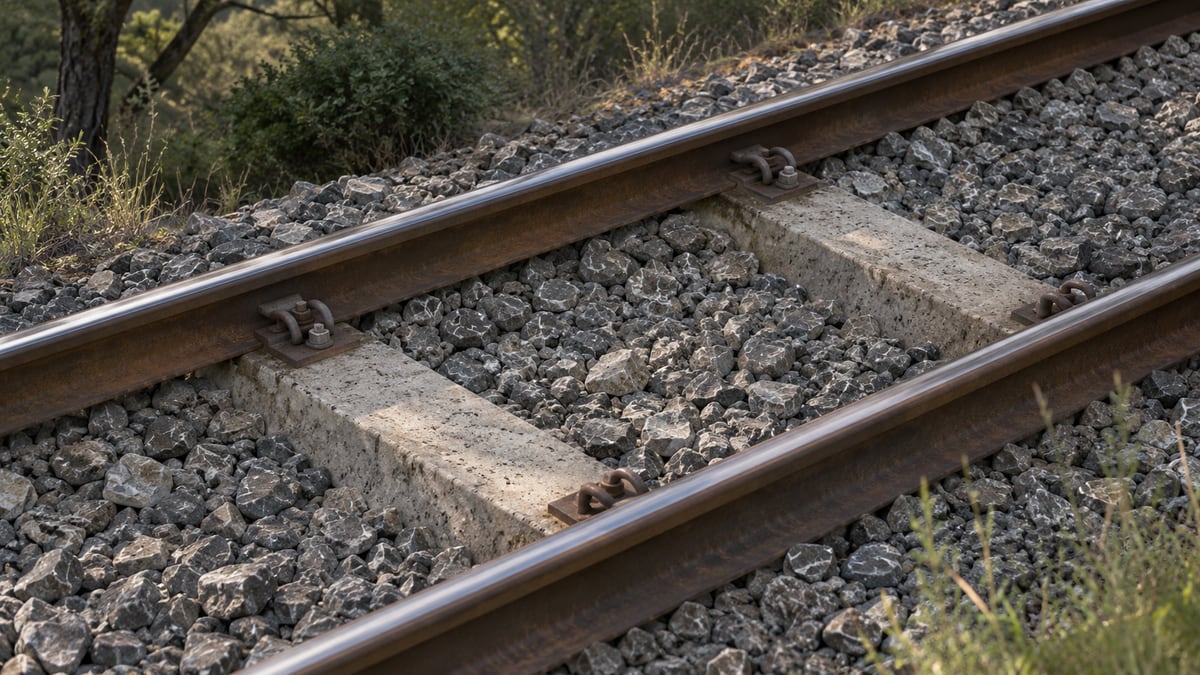
The Guardia Civil has told the woman judge of Court No. 2 in the Civil and Investigation Section of the Instance Court of Montoro, in Córdoba, who is handling the Adamuz rail crash, that the ballast and sleepers in the accident area date from 1990. On Sunday 18 January 2026, 46 people were killed and more than 150 were injured. The force's Organic Judicial Police Unit set this out in its 23 November 2026 report on the progress of the investigation, which Europa Press has seen.
On the section of track 1 between kilometres 316 and 320, the report records 37 metres of ballast recycled in 2023, 332 metres of new ballast from 2025 and 3,631 metres of original ballast from 1990. Officers say that at the exact derailment point and its immediate surroundings the ballast dated from 1990. They add that it remains for the judicial experts' report to determine whether the age of the ballast had any bearing on the breaking of the rail.
On the same stretch of track 1, there were 62 metres of sleepers recycled in 2023, 554 metres of new sleepers from 2025 and 3,384 metres of original sleepers from 1990. At the exact derailment point and its immediate surroundings, the sleepers dated from 1990.
For the rails on that part of track 1, the report lists 37 metres from 2023 made by Arcelor, 530 metres of new rail from 2025 also made by Arcelor, and 3,433 metres from 1990 made by Ensidesa. At the exact derailment point, a 256-metre section from 2025 joined a 1,319-metre section from 1990, with the corresponding weld.
Asked about the possible safety effect of the age of the materials, the judicial experts told officers that the age of any material always contributes to a decline in its performance, for example in geometry or strength, and that wear or ageing indicators and maintenance plans are therefore established. To check whether Adif has adapted its maintenance rules to the age of the materials, the high-speed rail traffic the line carries and especially the marked increase in traffic since new operators entered service, the Guardia Civil has asked Adif for the maintenance plan covering sleepers, ballast and rails.
On the welds, the Guardia Civil report notes that Adif's rules require an R260 force weld where used rail coupons are joined to new ones, so an incorrect force kit would have been fitted. Adif accounts for this through an error correction dated 29 January 2026, eleven days after the crash, in an erratum signed by an Ayesa welding inspector. That document says the welder made an error and recorded the kits for welds 5 and 6 in positions 3 and 4, and the reverse.
The report says that if a UTE inspector took part in the aluminothermic welds made during the renewal of points in the Adamuz area and carried out ultrasonic tests, as stated in the inspection reports supplied, that inspector did not hold certification under the applicable standard. Of the ultrasonic tests on the welds, no records of any kind were kept beyond the final reports, in which every weld was declared fit. A second analysis of the data from the ultrasonic inspection of the weld at kilometre 318.681 on track 1, outer rail, which fractured, was therefore not possible.
The Guardia Civil says that, with no measurement records, the only course is to rely on the training, judgment and experience of the technicians who carried out the test, according to Redalsa when asked. Ayesa technicians performed the visual and geometric inspection, but there was no documentary supervision of the kits installed by the welding technicians. Officers add that only after the accident, when the welding-kit data were requested, did Ayesa correct the original report with the clarifying note.
The force says it cannot be documented that the ultrasonic inspection took place, because Adif has no record either of the technicians' access to the track or of work on the section where the welds to be inspected were located. It does appear in Redalsa work reports, in the statements of the two technicians who supposedly carried it out, and in the account of a UTE technician who accompanied them. If the ultrasonic inspection was carried out, one of the technicians did not meet the requirements set by the rules and did not hold the required level, and Adif's rules on access to the track and on carrying out the work would not have been met.
The report also says that at the accident's kilometre point there was a geometry defect, as shown by the geometric inspection of 13 October 2025. Because the last inspection was on 21 November 2025 and none followed, the condition of this rail on the date of the accident cannot be established from the documents. Officers state that the presence of these defects at that exact kilometre could have had a direct bearing on the breaking of the rail.
The report warns of a drop in tension in the track, recorded in the system on 17 January and continuing until the accident on 18 January. After study of the data series provided, that sustained change in tension over time is described as unusual. From the first tension drop on track 1 until the accident, 47 trains ran over that section.
The company Thales, responding to a request for technical information, said at the end of September 2026 that for the system to detect a broken rail it would be necessary to modify the entire electrical infrastructure of the line, reconfigure the catenary current returns, change the rail earthing concept, modify the connections of the catenary masts and increase the number of track circuits per block along the whole Madrid–Seville high-speed line.