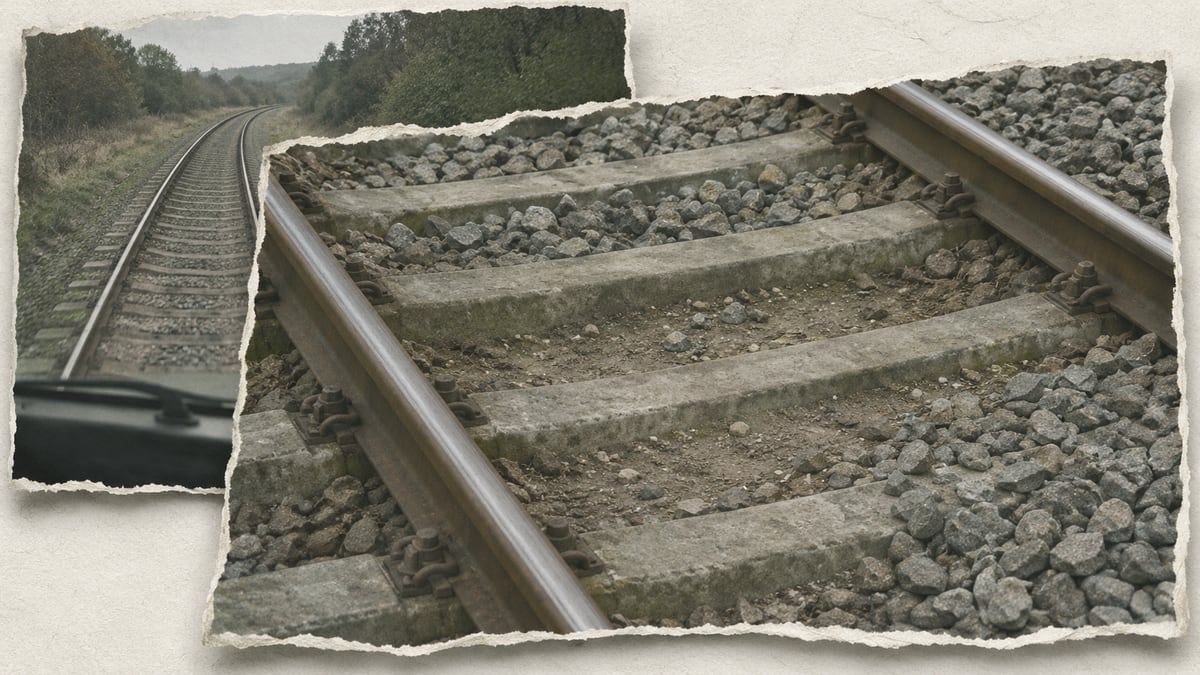
The Guardia Civil has found that months before the Adamuz tragedy, ballast was missing at the exact kilometre point where the rail broke and caused the train crash. A recording from October 2025 showed the gap. Experts investigating the case have asked for clearer copies of the images so they can take their inquiries further. The lack of these stones could have been decisive in the growth of a track dip that infrastructure manager Adif detected in November.
A video lasting 37 minutes and 22 seconds could be key to reconstructing what caused the Adamuz tragedy, in which 46 people died. It was filmed in the cab of a Renfe train running on track 1 from Seville toward Madrid on 31 October 2025. The images belong to the TrainData project and were sent to the court on a USB pendrive. The Guardia Civil received the video and set out its conclusions in a report that ABC has seen.
The officers say the recording begins on a stretch matching the outlying Córdoba neighbourhood of Villarrubia, at kilometre point 357, toward Córdoba-Julio Anguita station, and ends at about kilometre point 255, already in the province of Ciudad Real. At 20 minutes and 22 seconds the train reaches kilometre point 319, near the renewed section of the Adamuz turnout and a few metres from the crash site. Once past the catenary post marking kilometre point 319, they say, a large amount of ballast can be seen building up along the centre of the sleepers on track 1. That accumulation becomes increasingly visible, including at the signals 28 metres from the exact rail break, on track 1 at kilometre point 318+681.
To check the footage, the Guardia Civil compared it with the scene inspection carried out by criminalistics experts from the Instituto Armado. The report says that, in the 31 October 2025 cab recording, a large amount of ballast lies along the centre of the sleepers on track 1 at least 28 metres before the break at kilometre point 318+681, while at the precise point of the rail fracture ballast is absent on at least four sleepers of track 1.
Independent experts appointed to clarify the tragedy have asked for higher-quality images, confirmation of the recording date and, if possible, a tighter fix on the kilometre point where the images were taken. They consider the detail potentially very important for the rest of the investigation.
One hypothesis before the Guardia Civil and the experts is that the dip Adif detected at Adamuz triggered the rail break. The Guardia Civil said dynamic and geometric inspections found a small dip, at platform level, exactly at the break point in September. It had been corrected, but it reappeared in October. A November inspection showed the dip had grown compared with October. The track was not inspected again before the crash.
The officers also reported that some of the welds on which the break occurred were outside the geometric range. The weld where the break happened was slightly outside that range because supervisors were not interpreting the SGS procedure correctly and were applying a tolerance that in fact referred to the error margin of the measuring rule. The report says that until laboratory results are available it cannot be determined whether this was relevant to the break.