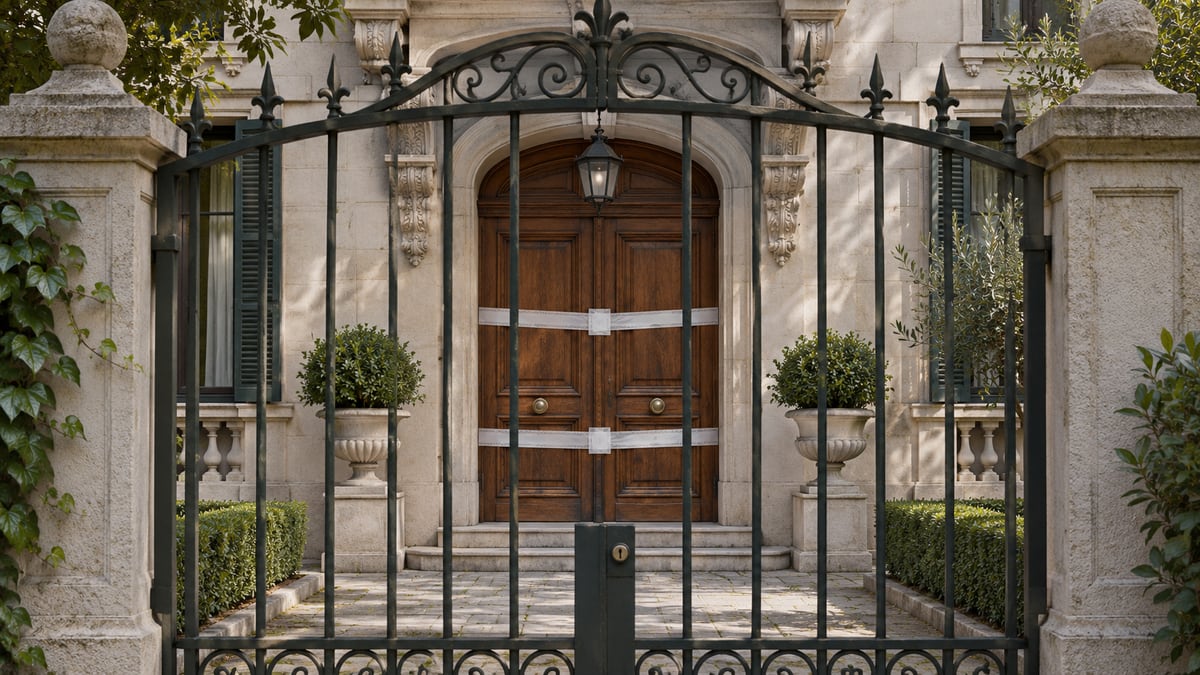
National Police have sealed a luxury brothel in a mansion in Madrid's El Viso after an investigation by Group VI of the Unit against Illegal Immigration Networks and Document Fraud (Ucrif), under the Immigration and Borders Brigade. A court ordered the closure. Five people were arrested for coercive prostitution, prostitution, criminal organisation and money laundering. When officers searched the house on 26 October, eleven women were inside being prostituted.
The property stands at 15 Calle de Carbonero y Sol in Chamartín, near Plaza de la República Argentina and Paseo de la Castellana. It covers 665 square metres on a 350-square-metre plot and has about a dozen rooms: bedrooms for the young women in the basement, further rooms on the floors above, and a top-floor apartment for the principal madam. It is valued at several million euros. The group had occupied it for years under a rental whose terms are now being examined, including whether the owner knowingly profited. Officers told ABC they had never seen anything comparable in a neighbourhood of that standing. For eleven years the house operated among residents who have included Hollywood actresses, presidents of elite football clubs, players, IBEX business figures and bankers.
Operation Norit, named with money laundering in mind, began after an anonymous tip this summer from a client. The message was written entirely in English and said the premises advertised as Masajes Eróticos Marabú in fact held many young women controlled by madams, mainly from Eastern Europe. The women came from Venezuela, Colombia, Spain and Paraguay. Ucrif can be contacted at [email protected] or on 900 10 50 90.
Surveillance found about 35 to 40 men arriving each day and staying roughly 45 minutes to an hour. The clients appeared affluent and arrived in high-end cars. Women aged 20 to 28 arrived between 11 and 11.30 a.m. and remained until midnight. They did not sleep there, because the house operated only by day. Neighbours told investigators the traffic was constant and suspicious.
During one discreet watch, officers spoke to a badly frightened woman who was in an irregular situation in Spain. She became a protected witness. She said that without papers she could not find work, and that a friend had told her the house wanted a receptionist or a cleaner. At the interview she was told those jobs did not exist and that she had to work as a prostitute, keeping 50% of her earnings while the organisation took the rest.
Investigators say the group used that vulnerability, and the same pressure on other women. They had barely one free day every fortnight, had to stay available throughout their hours in the house, could be sent out to provide services, were required to perform oral sex without a condom, and could not choose clients. Clients picked them in advance from a website catalogue listing 29 women. They also had to sign standard room-rental contracts so their presence looked lawful. The protected witness said she does not use drugs, but that drugs were sold there. Investigation sources told ABC that prostitution houses and flats of this kind function as drug flats and that substances are sold in all of them.
Madrid Ucrif asked a violence-against-women court, which has dealt with these cases for the past year, for permission to enter. On 26 October an undercover officer called at about 1 p.m., posed as a client, and the rest of the team went in when the door opened. Eleven women were ready to provide services. Officers arrested three madams, one Romanian, one Spanish and one Ukrainian, and two Spanish men who rented the house. Until 2025 the men had been registered as self-employed; since then they had no apparent work.
Police monitored four companies, one linked to a man and a Brazilian woman. The search found four card terminals, one for each firm, described as the main means of laundering prostitution money. One company was for room rental. Eleven bank accounts are blocked and under investigation. Officers also seized 35,000 euros in cash and a large number of terminal receipts, kept by a madam in four envelopes.
An hour-long service cost 200 euros. On that basis police estimate the group took about 4,000 euros a day, at least 1.5 million euros a year. Cocaine was found in locker number 3, supposedly assigned to the exploited women, though none said it was hers. The locker also held a company stamp and the women's work rotas. Because nobody was registered as living there, the brothel was sealed by court order. One of the madams said it had been operating for eleven years.