Juanma Moreno, president of the PP in Andalusia and of the Junta de Andalucía, voted at Colegio Sagrado Corazón in Málaga and said he expects high turnout in a general election he called historic and fundamental for Spain’s future. María Jesús Montero, secretary-general of the PSOE in Andalusia and deputy secretary-general of the PSOE, voted at SAFA Nuestra Señora de los Reyes on Calle Calatrava in Seville and said she was very hopeful. Manuel Gavira of Vox, second vice-president of the Junta and its councillor for tourism, justice, deregulation and local administration, as well as leader of the Vox group in the Andalusian parliament, voted at Colegio San Vicente de Paúl in Cádiz and called for a massive vote to open a new stage.
Antonio Maíllo, federal coordinator of Izquierda Unida and spokesperson for Por Andalucía, voted at Colegio Salesiano Santísima Trinidad in Seville and said he believes turnout will be massive on a day crucial for the country. Antonio Sanz, first vice-president of the Junta, its councillor for the presidency, health and emergencies, and the PP’s national coordinator for interior and emergencies, voted at Colegio Esclavas San José in Cádiz and said he trusts in a very large mobilisation because people know a great deal is at stake.
Polling stations close at 20:00, and the first provisional results are due from 21:00. Moreno was to follow the night in Seville at the regional headquarters of the PP in Andalusia, with his team and in contact with the PP’s national leadership. Montero and Maíllo were to follow it in Madrid, Montero at Ferraz, the PSOE headquarters.
Moreno did not vote alone. He was accompanied by Francisco de la Torre, mayor of Málaga, Carolina España, third vice-president of the Junta and its councillor for economy, finance and European funds, and Elías Bendodo, the PP’s deputy secretary for autonomous, local and electoral-analysis policy and its candidate for Congress in Málaga, among others. Moreno called the election historic because of the many open expectations around it and the level of participation there may be across Spain. He said reports reaching them showed a lot of movement at the ballot boxes and polling stations, a sign that citizens were taking the election very seriously. He said he wants the day to pass without any incident across Andalusia and Spain and to proceed with complete normality, and that every citizen should be able to vote freely, without limitations or fears, and with clarity and joy. He described democracy as something to conserve, protect and care for, and election day as a celebration.
He said he hopes it will not be a very long night and that every polling station can close at 20:00, because knowing the result sooner would be better for everyone. He also said the last seat will be closely fought in some provinces, which is why he expects an exciting election. He said what happens in Andalusia will markedly shape Spain’s future: it is the region that elects the most seats, and Andalusians vote with a double responsibility because their population conditions the government of Spain. Andalusia elects 60 of the 350 deputies, one fewer than in 2023, because Cádiz lost a seat that Madrid gained, taking Madrid from 37 to 38.
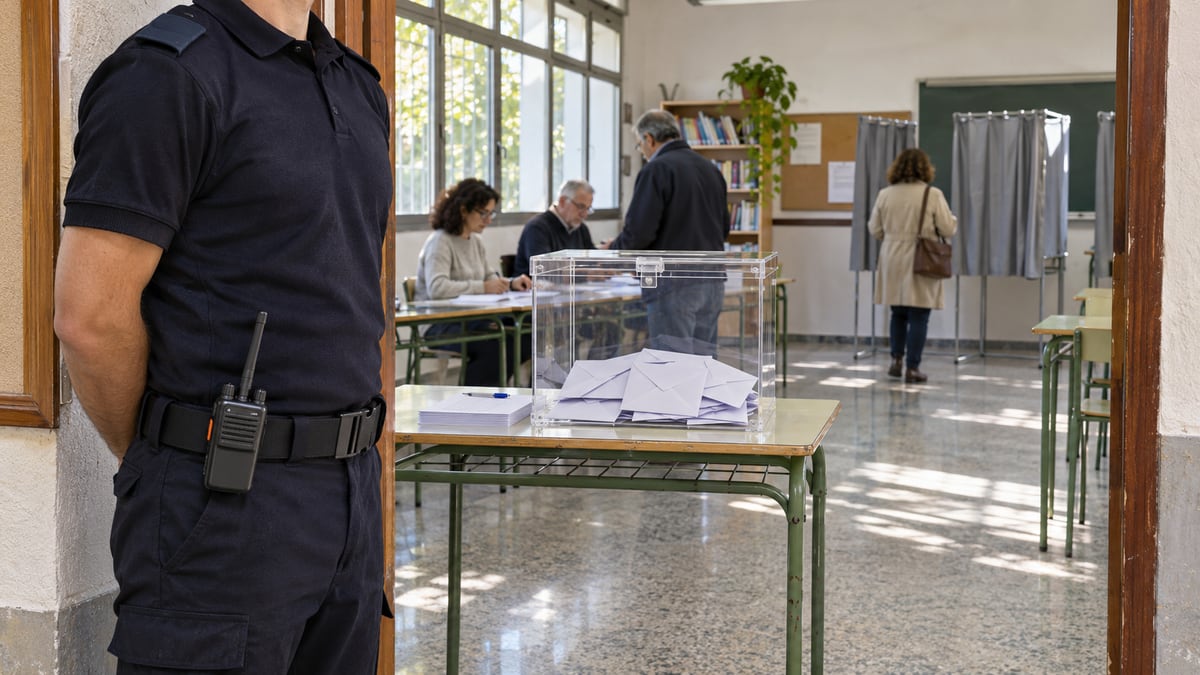
Asked about bomb threats, Moreno said he hopes there will be none, because they would hinder polling stations and could delay the count. He said he expects the day to pass normally and recalled a large deployment of the state security forces, with a special operation to detect anyone who makes the joke of calling in a threat. He warned that this could cost the caller a criminal reproach rather than merely a sanction, and told anyone thinking of playing that joke today to be careful. Criminal Code article 561 punishes anyone who falsely claims or simulates a danger to the community that causes the police or assistance or rescue services to mobilise. The penalty is three months and one day to one year in prison, or a fine of three to eighteen months.
Moreno’s plan afterwards was the usual one: breakfast with colleagues at Bar La Canasta, where he goes whenever he votes and which he said has always brought him luck. He said his only superstition is always having breakfast in the same place.
Montero called it a very important day for Spain and its future and asked for a large mobilisation so that future is the one citizens choose. She said the way to strengthen democracy is to make the right to vote real by taking part. She thanked polling-station presidents and members, volunteers, and the state security forces present at every polling station. She said she has no doubt the day will pass in complete normality, and that as the PSOE’s representative she and her colleagues were voting very hopeful and very happy. She said she would be with colleagues in Ferraz for the count and would afterwards do something she could not disclose at that moment, but which has to do with the election results.
Gavira said this was the day millions of Spaniards had been waiting years to see arrive. He said the day would end a wretched stage in the nation marked by lies, corruption and tragedies, and said it had been hard to see compatriots dying in blackouts, in danas and in rail disasters. At least seven deaths have been linked to the blackout of 28 April 2025, and the dana of 29 October 2024 left 229 dead in Valencia. The train crash at Adamuz, in Córdoba, on 18 January left 45 dead. In the crash at Urda, in Toledo, on 28 October, 69 dead victims have been identified, and what happened at Urda remains under investigation.
Gavira said that stage ends today and that from Monday 30 November another will begin in which Spaniards come first, the administration serves Spaniards rather than the reverse, Spaniards who left will return, and everyone who did not enter through the door of legality will leave. He asked people in Cádiz, Andalusians and Spaniards to fill the ballot boxes massively and calmly, saying that if Spaniards vote, the country will have a new stage tomorrow.
The stage he said he wants is a Spain of housing, trains, good public services and the countryside, and a Spain that defends the state security forces serving abroad. Above all, he said, he wants a Spain of Ceuta and of El Hierro, which he said remain invaded and which he said must be mentioned every day. What happened in Ceuta was the entry of about 13,000 people on 30 and 31 July, the figure given by the Government of Ceuta. At El Hierro the arrivals are cayucos: on Saturday 14 November, 12 cayucos reached the island with 1,235 people, and 1,488 people reached the Canary Islands as a whole that day. According to the Interior Ministry, 11,037 people arrived in the Canaries in 106 boats in the first fifteen days of November, and 24,364 arrived from 1 January to 15 November, 65.9% more than in the same period of 2025.
After voting, Maíllo said his impression is that turnout will be high, that citizens have a stimulus to take part, and that he is convinced participation will be massive. He thanked the 10,000 proxies and polling observers he said Frente Amplio has registered for the election, said the coalition’s campaign had been on the rise, and said it seeks a society with social justice. He said expectations, mobilisation and enthusiasm had risen strongly, and he praised what he called the stellar performance of Ada Colau, Frente Amplio’s candidate for prime minister of Spain, in the four-way debate on Thursday 26 November. He spoke of building an expectation of sympathy that he hopes will become the support the coalition wants for the common good and for the happiness of most people. He too was following the night in Madrid. He said every vote is decisive and that each citizen will vote as he or she sees fit, with nobody telling them what to do or which calculation or marketing operation to follow.
Sanz said calling people to vote is the best thing that can be done for the democratic celebration that election day always is, and that as a democrat he wants a very large mobilisation because Spain is playing for its future. He said the day had begun without incidents. He thanked the 21,293 officers assigned so that everything proceeds normally: 11,243 from the Guardia Civil, 7,353 from the Policía Nacional and 2,697 from local police forces, together with staff of the Policía Nacional unit attached to the Junta de Andalucía and the 4,899 administration representatives at the polling stations. The Interior Ministry figure for Andalusians called to vote is 6,833,904, in 3,756 polling stations in the region. Sanz said what stands out most is normality on a very fine day, and he asked people to vote massively.